Willis family
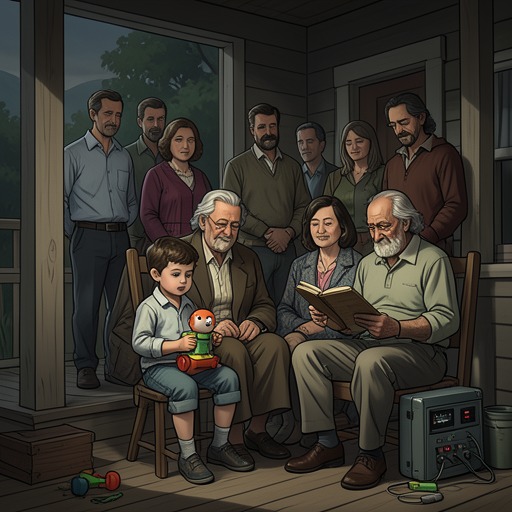
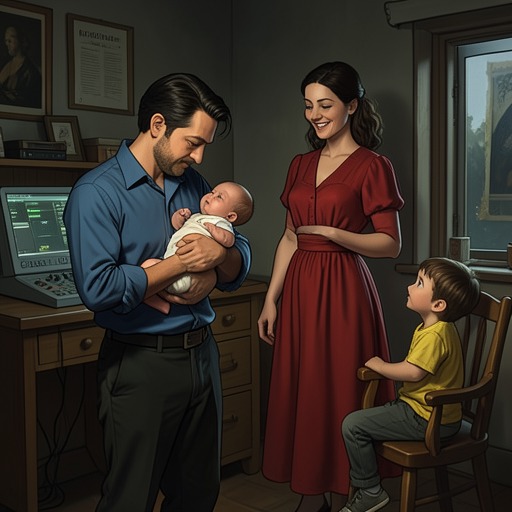
Are We Having Fun YetThe Willis family is the ten-child household through which the book examines large-family life as both demanding practice and sustaining community. From the inside, its size feels normal; from the outside, it becomes a spectacle. Yet the family’s decisive significance lies not in the number ten alone, but in the habits that give that number structure: parents who support one another, children included in family decisions, repeated rituals such as dinner, and a capacity to convert inconvenience, rivalry, and public curiosity into humor and belonging.
Identity and Everyday Structure
The family’s particular methods of managing daily life were part of what it meant to be “one of the Willises.” The children did not experience these arrangements as exotic while they were growing up. Their sense of difference emerged when outsiders stared at their shopping carts at the A&P, asked whether they were a Brownie troop at playgrounds, counted them in the car at a red light, or saw the family’s Christmas photograph displayed at Levy Brothers as an advertisement for Santa pictures. Public attention made the household conspicuous, but it also sharpened the children’s awareness of their collective identity.
That identity was accompanied by pride. The narrator remembers arriving at dorm life at Georgetown University and realizing that, for the first time, she had her own underwear. She was angered by classmates who wondered whether she actually knew all her brothers’ and sisters’ names; she could still recite their names and birthdays, even if calculating their current ages required a pause. As the eldest child, she also watched the younger children pass through developmental stages, eventually predicting those stages as Jerry and Danny grew up. The family therefore produced not anonymity but an unusually detailed memory of one another.
The household’s scale required practical systems. On vacations to the parents’ summer home, packing six or more children and two adults was organized through a six-drawer cardboard chest, a laundry basket, and one suitcase for Dad. Each girl received a drawer and had to fit everything she wanted to bring inside it; the boys and their mother used the laundry basket. The car had to preserve room for bodies as well as luggage, so five children traveled in the very back of the station wagon, three in the middle seat, and the old baby and new baby sat up front with their mother. The apparent improvised quality of these arrangements concealed careful planning.
Parental Partnership and Care
The family’s relative ease did not arise because its mother was unusually gifted, naïve about the burdens of parenting, or immune to exhaustion. She explicitly attributes her enjoyment of mothering ten children to the help and support of her mother and her husband, Bub. Their repeated insistence that at least three of the Rs be present in her life made care for the caregiver part of the family’s operating principle. They reminded her that she was important and that no one else could do what she was doing; where no one else could provide that care, she understood that she had to provide it for herself.
This support made enjoyment possible without pretending that every moment was easy. The mother was busy and endured severe nausea during pregnancy, but she remained young and enjoyed her children. When she called “EMERGENCY,” the girls stopped what they were doing and sat still so they would not get into danger while she was sick. For a long time, their meaning of emergency was simply someone becoming ill to her stomach; when an emergency vehicle passed the house, they identified it by calling it an “EMERGENCY.” The episode turns maternal vulnerability into a family game and shows children learning to respond collectively to an adult’s temporary incapacity.
The family’s ideal was not that mothers alone should carry parenthood. The book acknowledges single mothers and women whose husbands work such long hours that they feel like single parents during the week, while still presenting two parents happily sharing both the responsibilities and joys of raising children as an ideal. In the Willis household, Bub’s participation was especially visible through his determination to return home for dinner. Even during stressful weeks, when his wife considered feeding the children early and preparing a quiet meal for the two of them, he objected because he worked in order to come home to be with the children.
Dinner as a Family Institution
The Willis dinner hour was the household’s central daily ritual and one of the chief mechanisms holding the family together. Bub was affectionately called “St. Grumpy” because spilled milk and domestic disorder could make him roar like a lion, yet he was home for dinner with his ten children almost every evening. In retrospect, the shared meals appear as a major contribution to the family’s strong connection: the table was a place where information, opinions, lessons, and humor circulated.
Dinner also established a temporary equality among family members. The infant seat could occupy the center of the table and the toddler might sit in a high chair, but everyone could make eye contact with everyone else. The children participated in important family matters, were encouraged to express opinions, and learned to listen to one another. Because their mother had spent much of the day with them, Bub had the first opportunity to answer the question of how his day had gone. He answered seriously and fully, and then each person took a turn telling something that had happened.
The ritual became part of the family’s public mythology. An extended table could seat eighteen, twenty, or more diners, and visiting high-school friends, college classmates, and adult acquaintances regarded the gathering with wonder and amusement. When a high-school talent show needed acts for a fund-raiser, Bub and his wife staged a comic imitation of the Willis dinner hour. Two boys carried oversized platters, exaggerated bowls and containers enlarged the visual scale, and a huge table made the family’s ordinary abundance theatrical. The performance shows how the family could turn the very feature that made it seem strange to outsiders into a shared comic language.
Community, Conflict, and Continuity
The Willis family’s ability to function economically depended partly on relationships beyond the home. Weekly visits to the A&P became organized around personal ties with vendors. Larry Mooney selected the best produce and opened a checkout line for the five or six carts the family filled each week. Ginsberg’s, Wechsler’s, and Milton Bodner’s opened their doors for several private hours before sale days so the mother could clothe all ten children at special prices. The lesson drawn from these exchanges is that a large family can be supported by a village when it also gives recognition and respect back to that village.
The family’s internal life was not free of strain. Sibling conflict could become prolonged and physically serious, particularly between Ben and Tim, who were almost two years apart. During their adolescence, their mother repeatedly had to stand between them to stop their fights. The conflict lasted for years, and she feared that they might permanently injure one another or eventually need to live in separate parts of the country. Their relationship began to improve perhaps when they played varsity football on the same high-school team, or perhaps later, when they lived in different states during college. The uncertainty about the exact turning point underscores the gradual, nonheroic nature of reconciliation.
The rivalry finally acquired a happy family ending when Ben’s wife, Madeleine, gave birth to Benedict Patrick Willis IV in a New York City hospital. Five members of the family who worked in the city met at their favorite Irish pub while Ben’s sisters waited to learn which godparents had been chosen. The question of which brother would become godfather transformed an old rivalry into a new moment of kinship and ceremonial connection. A conflict once measured in years of fighting was absorbed into the next generation.
Meaning and Final Image
The Willis family is presented as a family system whose stability comes from repeated acts rather than from an absence of difficulty. Its members share burdens, meals, practical arrangements, memories, and arguments; the system absorbs pressure through humor, parental cooperation, and rules of participation. The household’s abundance is therefore social as much as numerical. Ten children create logistical problems, but the family’s habits convert those problems into recognizable roles and recurring stories.
That continuity is most powerfully tested near Bub’s death. Two nights before he died, all ten children gathered around his bed at home. Their mother chose home partly because no hospital room could hold ten people at once and she did not want them forced into a pattern of entering and leaving in pairs. Jerry arrived after taking his final senior examination and was expected to graduate from Cook College of Rutgers University the following week; the family knew Bub would not die in the middle of his exams. Although the end was near, Bub could still hear the family and acknowledge its presence.
Around his bed, the children took turns recalling happy times with their father, including memories shared by the group and experiences that belonged privately to individual children. The scene brings the family’s defining practices into its final crisis: gathering everyone together, making room for every voice, and using shared memory as a source of strength. The Willis family’s enduring portrait is consequently not simply that of a very large household, but of a structure capable of carrying its members from ordinary congestion and sibling warfare to collective remembrance and love at the edge of loss.